This post contains affiliate links. If you buy through them, we may earn a commission at no extra cost to you. It never changes which tools we recommend or how we rank them.
Quick Answer
The short answer: systeme.io for marketing makes sense when your marketing breaks down between the click and the sale. It puts funnel pages, email follow-up, automation, selling, and webinars in one dashboard, so a lead never sits in one tool while the follow-up lives in another. This guide walks through it by marketing job, not by feature list, so you can judge it against the campaign you actually run.
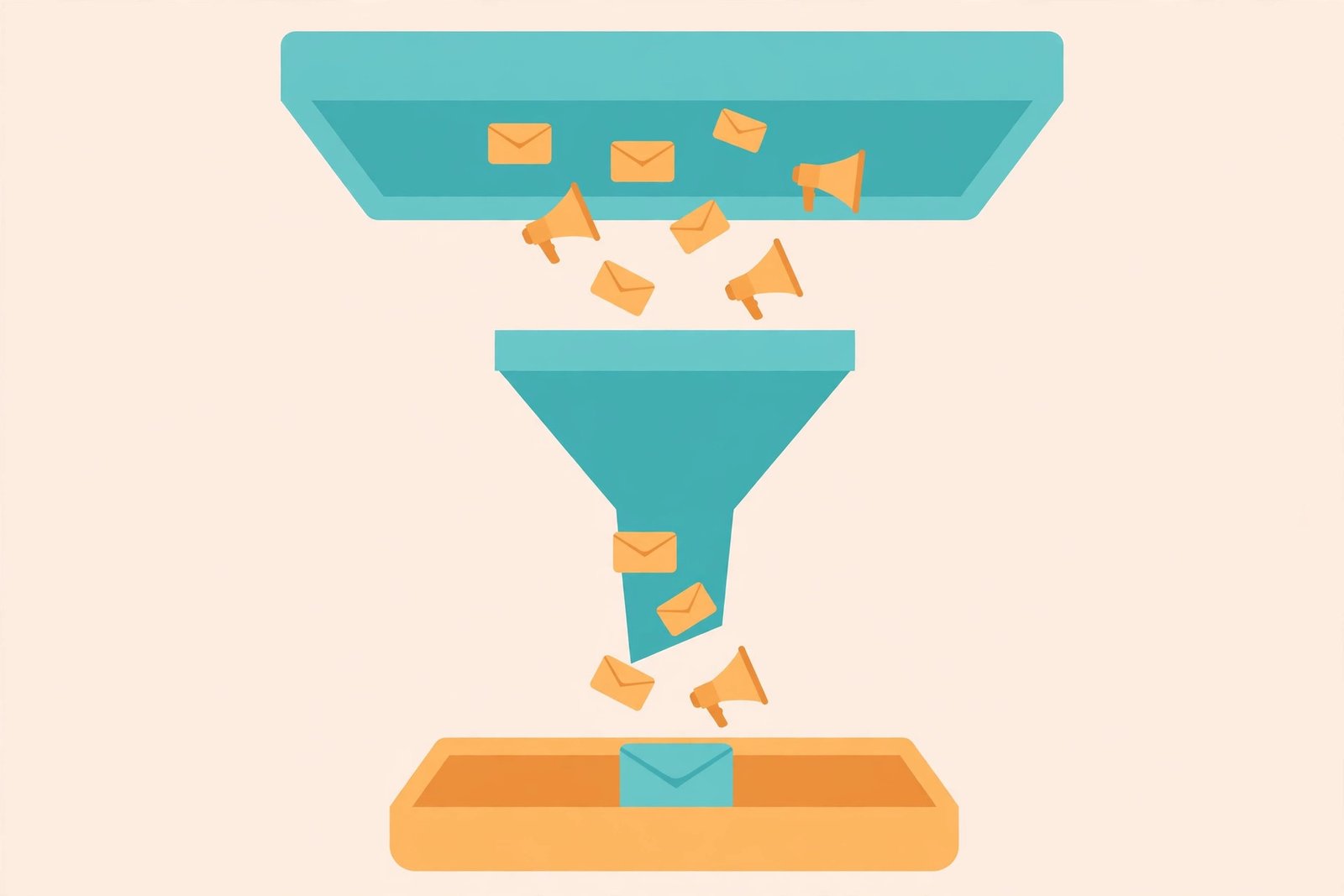
Most small marketing efforts do not fail for lack of ideas. They fail in the gaps. Someone clicks an ad or a post, lands on a page, and never hears from the business again. Or they join a list, get one welcome email, and then silence. Or they buy once, and nobody ever invites them back. Each gap looks small on its own. Added together, they are where most of the money goes missing.
Systeme.io for marketing is built around closing those gaps. It is an all-in-one online business platform, and its marketing value comes less from any single feature and more from the fact that the features share one contact list. A page visit, an email open, a purchase, and a tag all live in the same place, so the next step can happen without anyone copying names between systems or remembering to send a manual follow-up.
This post is not a list of fifteen tools. It is a deep look at one platform, judged the way a small business would judge it: what marketing jobs it covers, what a real campaign looks like inside it, what it costs, where it falls short, and who should wait before adopting it.
Systeme.io is a business platform, not an AI tool.
Stats Strip
- Free plan: $0, up to 2,000 contacts, 3 sales funnels, unlimited emails
- Paid plans: $17, $47, and $97 per month
- Transaction fees from the platform itself: 0% on every plan (payment processors charge their own fees)
- Core marketing jobs in one dashboard: funnel pages, email, automation, selling, webinars
Why Marketing Stacks Leak Customers
Before judging any platform, it helps to name the leaks it is supposed to fix. Here are the five most common ones for small businesses, and why they keep happening when tools are bought separately.
Leak 1: the page and the list do not talk. A visitor fills in a form, but the contact lands in a spreadsheet, or in a tool nobody checks daily. By the time someone replies, the visitor has moved on.
Leak 2: follow-up depends on memory. The business owner means to send a second email, a reminder, and an offer. Client work gets busy, the week passes, and the follow-up never goes out. Good intentions are not a follow-up system.
Leak 3: buyers and non-buyers get the same message. Everyone on the list receives the same broadcast, whether they already bought, almost bought, or only downloaded a free guide. The message feels generic because it is generic, and response rates show it.
Leak 4: selling needs a separate checkout step. The marketing page looks good, but buying means jumping to another system, another login, and another set of pages. Every extra step loses a share of buyers.
Leak 5: nobody measures the campaign as one thing. Page visits live in one report, emails in another, sales in a third. Nobody can answer the simple question: of the people who entered this campaign, how many bought, and where did the rest drop off?
A single dashboard does not fix a weak offer or a bad message. It does fix the plumbing. When the page, the list, the email, and the sale share one system, the leaks above become visible, and visible problems can be fixed one at a time.
What Systeme.io for Marketing Covers, Job by Job
This section follows the campaign, not the menu. Each job below is a marketing job a small business actually has to do, with what the platform provides for it and where the limit sits.
Job 1: turn attention into a lead
Every campaign starts with a page that asks for something small: an email address in exchange for a useful guide, a checklist, a short video, or a free consultation. The funnel builder provides drag-and-drop pages for this, with templates to start from, plus thank-you pages and sales pages that follow in the same path.
The practical point is the path, not the page. A visitor should move from first click to opt-in to thank-you page without hitting a dead end, and the contact they just gave should land straight on the list, tagged by which page they came from. That tag is what makes every later job possible, because it tells you what the person asked for.
The limit to know: page design flexibility is narrower than a dedicated page builder. If your brand depends on highly custom layouts, unusual animations, or pixel-perfect design, you will feel that limit. If your pages need to be clear, fast, and easy to build, the templates cover the job.
Job 2: follow up without depending on memory
Email marketing inside the platform covers two kinds of sending. Broadcasts go to the whole list or a segment at once, for announcements and offers. Sequences send themselves over days, so a new lead gets a welcome email, then a useful follow-up, then an offer, on a schedule you set once.
Tagging and segmentation are what keep this from turning into spam. A lead who downloaded a guide gets one path. A buyer gets another. A lead who clicked an offer but did not buy gets a reminder path. Each path is a separate sequence, and the platform moves people between paths when they act.
The free plan limit matters here, so read it before you plan: public pricing summaries list 1 email campaign and 1 automation rule on the free plan, with unlimited email sends. That is enough to run one real campaign and prove the workflow, but a business running several campaigns at once will outgrow the free plan quickly. Paid plans raise those limits, and that upgrade point is the honest moment to pay, not before.
Job 3: let routine steps run themselves
Automation rules are simple if-this-then-that rules across the platform. A form submission can trigger a tag. A tag can start a sequence. A purchase can move a contact to the buyer list and stop the sales sequence. A click can trigger a different offer.
This is the job that saves the most time, and it is also the job where beginners overbuild. The rule that works is the smallest one that removes a manual task you actually repeat: the welcome sequence after opt-in, the buyer follow-up after purchase, the reminder after a missed step. Ten clever rules nobody understands are worse than three simple rules everyone can explain.
Review summaries consistently flag the same trade-off: automation is easy to set up for straightforward paths, and tighter when many rules stack together. Plan your campaign with that in mind. Keep the path simple, and add complexity only when a real campaign result asks for it.
Job 4: sell without a second system
When the campaign reaches the offer, the platform provides checkout pages and order pages inside the same funnel, plus course hosting for businesses that sell knowledge. A buyer pays, gets access, and lands on the buyer list in the same motion, with no export step in between.
That single motion matters for marketing because it closes the measurement loop. You can count, for one campaign, how many people entered, how many reached the offer, and how many bought. Without that count, every marketing opinion is a guess. With it, you can test one change at a time: a clearer headline, a shorter form, a better follow-up email, a different offer order.
The platform charges 0% transaction fees itself, on every plan including free. Payment processors still charge their own processing fees, as they do everywhere, so judge the real cost as platform price plus processor fees, not platform price alone.
Job 5: run your own affiliate program and live sessions
Two further marketing jobs sit in the same dashboard, and both suit businesses that have outgrown a single funnel. First, you can run your own affiliate program: other people promote your offer, and their sales are tracked inside the platform. That turns happy customers and partners into a distribution channel, without a separate affiliate system.
Second, paid plans add evergreen webinars and communities. A recorded presentation can run as part of an automated funnel, so the same talk works while you are doing other work, and a community gives buyers a place to stay after purchase. Neither job matters on day one. Both matter when one funnel works and you want more people walking through it.
A 14-Day Campaign You Can Actually Run
Theory is cheap, so here is a concrete campaign shape that fits the free plan limits and the jobs above. It assumes one offer, one lead magnet, and a small list. Scale it only after it works once.
| Days | What to build | What success looks like |
|---|---|---|
| Days 1 to 3 | One funnel: opt-in page, thank-you page, sales page for the main offer | A visitor can complete the path with no dead ends |
| Days 4 to 6 | One email sequence: welcome, the problem, the solution, proof, the offer | Five emails written, scheduled, and tested on your own inbox |
| Days 7 to 8 | Tags and checkout: buyers tagged separately from leads, purchase stops the sales sequence | A test purchase moves a test contact to the buyer path |
| Days 9 to 11 | Traffic, one channel only: send the funnel to one audience you already reach | At least one real channel sending real visitors, not five half-started ones |
| Days 12 to 14 | Measure one campaign: entries, offer views, purchases, and the biggest drop-off point | One number for each stage, and one change chosen for the next round |
The discipline in this plan is what it leaves out. One funnel, not five. One sequence, not three. One traffic channel, not every channel. Most failed campaigns fail from starting too wide, not from a missing feature. When the 14 days are done, the campaign has either earned its next round or shown you exactly which stage needs work, and that answer is worth more than another month of planning.
Pricing, Plan by Plan
Prices below come from public pricing summaries checked on 1 November 2026. Check the official pricing page before you pay, because prices and plan limits change over time. Annual billing is described in those summaries as giving two months free. Some public summaries also flag a lifetime sales cap on the free plan, so check the current terms before you scale paid sales on the free tier.
| Plan | Price per month | Contacts | Sales funnels | What it adds for marketing |
|---|---|---|---|---|
| Free | $0 | Up to 2,000 | 3 | One course, one blog, one email campaign, one automation rule, unlimited emails, 0% platform transaction fees |
| Startup | $17 | Up to 5,000 | 10 | More funnels and courses, more automation rules, more custom domains |
| Webinar | $47 | Up to 10,000 | 50 | Evergreen webinars, larger lists, larger funnel capacity |
| Unlimited | $97 | Unlimited | Unlimited | All limits lifted, plus sub-accounts and free migration on the top plan |
Read the price the right way. The free plan is genuinely usable for one campaign, not a demo that expires. The $17 plan is the first real step up, and it arrives when funnel or automation limits start blocking a working campaign. The $97 top plan is still below the entry price of several separate tools bought one by one, but that comparison only matters if you actually use at least three of the jobs in this post. One job alone does not justify an all-in-one price.
One pricing caution from public review summaries: sending email campaigns requires an email address on your own domain. Set that up before launch week, not during it, so a small setup step does not delay a campaign that is otherwise ready.
Pros and Cons, Plainly
| Pros | Cons |
|---|---|
| Funnel pages, email, automation, selling, and webinars share one contact list | Page design is less flexible than a dedicated page builder |
| Free plan covers a full first campaign with no credit card needed | Free plan limits (one campaign, one automation rule) are outgrown fast by multi-campaign businesses |
| No-code setup: one person can build a campaign without a developer | Automation gets tight when many rules stack together |
| 0% platform transaction fees on every plan | Reporting is solid for campaign stages, not deep enterprise analytics |
| Paid plans stay low compared with buying each job as a separate subscription | Integration library is smaller than larger platforms, centered on payments |
| Running your own affiliate program is built in, not bolted on | Not built for large teams, complex pipelines, or multi-client agency dashboards |
The pattern in that table is consistent across public review summaries: breadth and simplicity are the strengths, depth and design freedom are the trade-offs. A business that needs one connected campaign will feel the strengths. A business that needs the deepest version of any single job will feel the limits.
Who It Fits, and Who Should Wait
Fit is better judged by marketing situation than by business size alone.
It fits well if you are a solo creator, coach, consultant, or small shop selling one main offer. Your marketing is one funnel, one list, and one follow-up path, and you need it running without hiring help or learning five systems. It also fits if you sell a course or a digital product and want the sale, the delivery, and the follow-up in one place.
It fits well if follow-up is your known weak spot. You already get visitors or inquiries, but too many go quiet after first contact. A platform that automates the second, third, and fourth message attacks your actual problem, not a problem you imagine having.
Wait if you need design-led marketing. If your pages must look like a design studio built them, with custom layouts no template can match, start with a dedicated page builder and accept the extra cost and stitching work. Forcing an all-in-one platform into a design job it was not built for wastes the money it was supposed to save.
Wait if you run many campaigns for many clients. Multi-client dashboards, deep permissions, and complex pipelines belong on agency-grade platforms. This platform is built for one business running its own campaigns, and stretching it across many clients will expose that.
Wait if you have no offer and no audience yet. No platform creates demand. If nobody visits your pages and you have nothing clear to sell, fix the offer and find the first audience first. Then a campaign tool has something real to capture and follow up on.
Common Mistakes to Avoid
Building five funnels before one works. Every funnel you build before the first one converts is a guess multiplied. Prove one path, then copy what worked.
Writing the sequence last. The emails are the campaign, not an afterthought to the pages. Write them before you drive traffic, and test them on your own inbox first.
Tagging nothing. A list with no tags is a list you cannot segment, and an unsegmented list gets generic messages. Tag by source page, by purchase, and by the one action that matters for the next message.
Measuring visits instead of stages. A thousand visits with no stage counts tells you nothing. Count entries, offer views, and purchases for one campaign, and fix the biggest drop first.
Paying before the free limit bites. The free plan exists to prove the workflow on real work. Upgrade when a limit blocks a campaign that already works, not when a feature list looks impressive.
Frequently Asked Questions
What is systeme.io for marketing?
It is an all-in-one platform that covers the marketing path from page to lead to follow-up to sale: funnel pages, email marketing, automation rules, checkout, course selling, your own affiliate program, and, on paid plans, webinars and communities, all sharing one contact list.
Is systeme.io for marketing good for small businesses?
Yes, that is its strongest fit. Small businesses usually need one connected campaign more than they need the deepest version of any single tool, and the free plan lets them run that first campaign before paying.
Is there a free plan?
Yes. The free plan costs $0, needs no credit card to start, and covers up to 2,000 contacts, 3 sales funnels, one course, one blog, one email campaign, one automation rule, and unlimited emails, with 0% platform transaction fees. Check the official pricing page for current limits before you build.
Can systeme.io for marketing replace a separate email tool?
For campaigns where email follows a funnel or a purchase, yes, because the email, the page, and the sale share one list and one set of tags. If you only ever send a simple newsletter and need nothing else, a single-purpose email tool is simpler.
How does automation work in systeme.io for marketing?
Automation uses simple rules: an action, such as a form submission or a purchase, triggers a tag, an email sequence, or a move to a different list. Keep rules simple and few, and add complexity only when a campaign result asks for it.
Can I run webinars with systeme.io for marketing?
Evergreen webinars are included on paid plans, starting with the Webinar plan. A recorded presentation can run inside an automated funnel, so it keeps working without a live session each time.
Can I run my own affiliate program?
Yes. The platform includes tools to run your own affiliate program, so partners and customers can promote your offer and have their sales tracked inside the same system.
What does systeme.io for marketing cost?
There is a free plan at $0. Paid plans are $17, $47, and $97 per month in public pricing summaries, priced by contacts and features, with annual billing described as two months free. Prices and limits change, so check the official pricing page before buying.
Conclusion
Systeme.io for marketing earns its place when the gap between click and sale is your problem. One dashboard covers the funnel page, the email follow-up, the automation, the checkout, and the next invitation, and one contact list ties them together so no lead waits on a manual step that never happens. It will not design award-winning pages, it will not run a large agency, and it will not create demand where none exists. But for a small business with one clear offer and a follow-up problem, it is the simplest complete campaign system at the lowest starting price.
Start with one funnel, one sequence, and one campaign measured stage by stage. In fourteen days you will know, from your own numbers rather than a feature list, whether it earns its place in your marketing.
Leave a Reply